


Gutters, roof snow, tree limbs, cobwebs, light bulbs: here's how to handle every high-reach task around your home safely from the ground, no ladder required.
Every year, roughly half a million Americans end up in emergency rooms because of ladder falls, and the overwhelming majority of those injuries happen at home, during ordinary chores like cleaning gutters, changing a light bulb, or hanging holiday lights. Ladder-free home maintenance isn't a compromise or a workaround. For most high-reach jobs around a house, it's simply the better way to work: faster to set up, safer by design, and easier on your body.
This guide covers every common high-reach task around a home, including gutters, roof snow, tree limbs, cobwebs, light bulbs, and hanging and retrieving. It shows you how to handle each one with both feet planted firmly on the ground.
Why the Ladder Is the Most Dangerous Tool You Own
The numbers are sobering. The U.S. Consumer Product Safety Commission and CDC consistently report hundreds of thousands of ladder-related injuries treated in U.S. emergency rooms every year, with several hundred deaths. A widely cited study in the American Journal of Preventive Medicine found that more than 97% of ladder injuries happen in non-occupational settings. In other words, they happen not on job sites with safety training and harnesses, but at home, on a Saturday, doing exactly the kind of chores this guide is about.
~500,000
Americans treated in ERs for ladder falls every year
97%
of ladder injuries happen at home, not on job sites
21 ft
of working reach from the ground with a 16 ft pole
The risk also climbs with age. Falls are the leading cause of injury among adults 65 and older, and a fall from even six feet onto a driveway can mean broken hips, head injuries, and months of recovery. The most common ladder-injury scenarios read like a list of routine home maintenance: cleaning gutters, trimming branches, clearing roof snow, changing hard-to-reach bulbs.
Here's the part worth sitting with: almost none of those tasks actually requires a ladder. They require reach. And reach is a problem you can solve from the ground.
The Extension Pole System: One Pole, Every Job
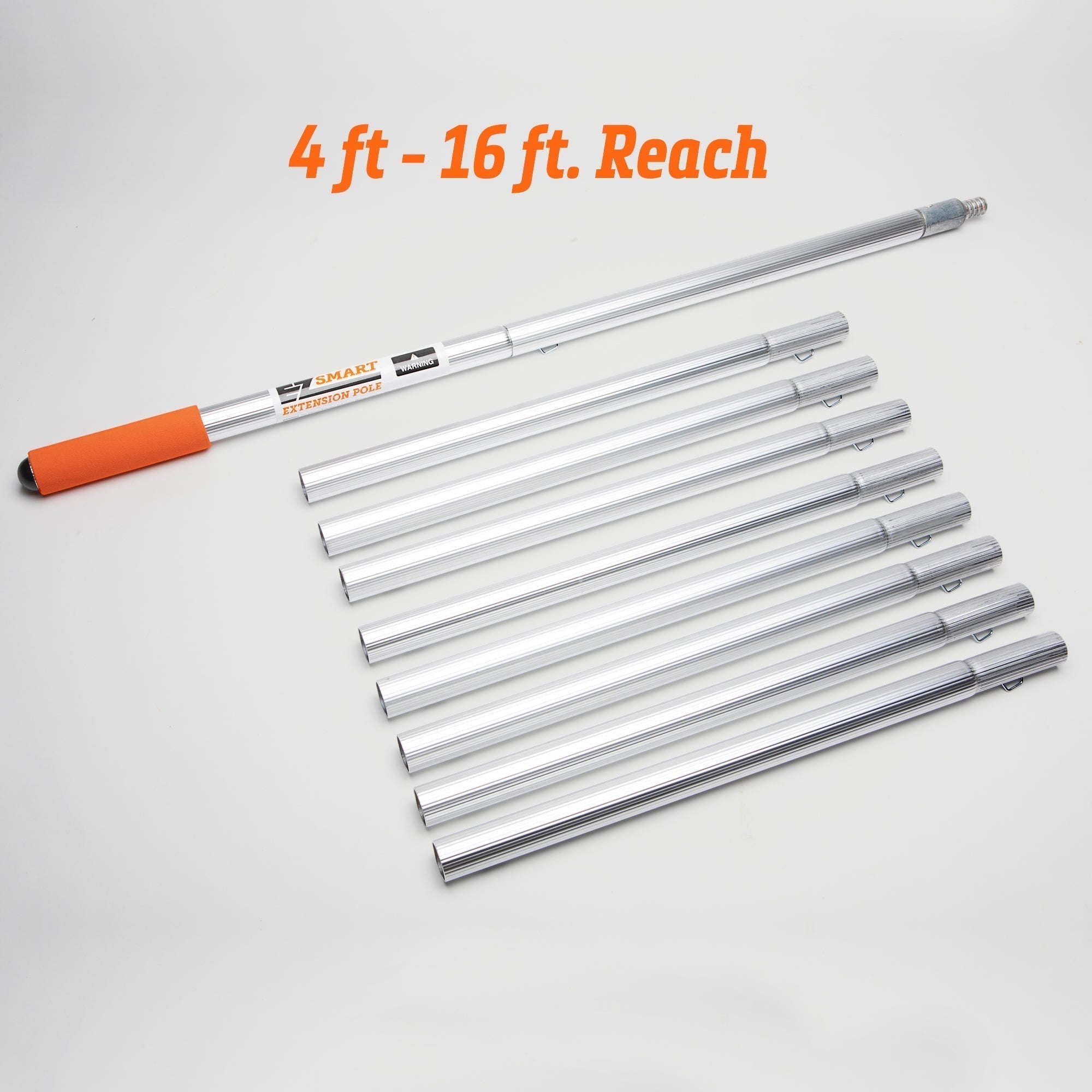
The foundation of ladder-free maintenance is a sectional extension pole with a standard 3/4″ ACME thread, the same universal thread you'll find on paint rollers and squeegees. A quality 16 ft extension pole gives you roughly 21 feet of working reach once you account for your own standing height and arm extension. That's second-story gutters, most residential rooflines, and the upper canopy of ornamental trees, all reachable from your lawn.
Because the thread is standardized, one pole powers an entire toolkit. Thread on a gutter rake in the spring, a pruning saw in the summer, a snow rake in the winter. The pole is the platform; the attachments are the tools.

Every High-Reach Job, Solved From the Ground
Gutter cleaning
A narrow rake head sized to fit inside a standard K-style gutter channel pulls out leaves, twigs, and seed buildup directly, and the same profile sweeps debris off the top of installed gutter guards without removing them. Pair it with a clamp-on inspection mirror and you can see exactly what you're clearing as you work. Full walkthrough: How to Clean Gutters Without a Ladder.
The tool for the job Gutter Rake + Inspection Mirror →Roof snow removal
Heavy snow loads stress roof framing and feed ice dams at the eaves. A wide-head snow roof rake lets you pull snow off the lower few feet of the roof from the ground, which is exactly where ice dams form. Never climb onto a snow-covered roof, and never lean a ladder against an icy gutter. Full guide: How to Remove Snow From Your Roof Without a Ladder.
The tool for the job Snow Roof Rake with 16 ft Pole →Tree trimming
A pole pruning saw with a bi-directional blade cuts on both the push and the pull stroke, letting you take branches up to about 21 feet overhead while standing well clear of the drop zone. Combine it with the three-cut method and you'll get clean cuts that protect the tree. Full guide: How to Trim High Tree Branches From the Ground.
The tool for the job Pruning Saw with 16 ft Pole →Cobwebs, ceilings, and fans
Vaulted ceilings, stairwells, exterior eaves, and soffits collect cobwebs faster than anywhere else in a home. A motorized cobweb duster does the twisting motion for you. No strained shoulders, no wobbling on a step stool over a staircase. Full guide: How to Get Rid of Cobwebs on High Ceilings.
Light bulbs
Two-story foyers and vaulted-ceiling fixtures are where step ladders become genuinely scary. A lighted bulb changer grips the bulb, lights the socket so you can see what you're doing, and swaps bulbs up to roughly 21 feet up.
Hanging, decorating, and retrieving
String lights, bird feeders, wind chimes, holiday decorations, plus the frisbee on the garage roof and the drone in the maple tree. A pivoting utility hook handles the hang-and-retrieve category that otherwise sends people up ladders a dozen times a year for thirty-second tasks.
Fruit harvesting
If you have fruit trees, a fruit picker with a foam-cushioned basket harvests apples, pears, oranges, and avocados without bruising, and without standing a ladder on the uneven, root-laced ground under a tree, which is among the worst ladder footings there is.

Choosing the Right Pole
Four things matter when you pick an extension pole:
-
Length
Add about 5 feet of standing reach to the pole length to estimate your working height. A 16 ft pole reaches roughly 21 ft, enough for most two-story gutter lines. Measure your tallest job before you buy.
-
Locking mechanism
The pole should lock positively at full extension with zero play. A pole that slips under load is a pole you'll stop trusting and stop using.
-
Weight
Aluminum is the sweet spot: stiff enough to control a tool head 16 feet away, light enough that your shoulders survive a full gutter line.
-
Thread compatibility
Insist on the standard 3/4″ ACME thread. It means every attachment you already own, including paint rollers, squeegees, and brushes, works on the same pole, and you're never locked into one brand's ecosystem.
Safety Tips for Working With Extended Poles
Ladder-free doesn't mean thought-free. A few habits keep pole work safe and comfortable:
⚠ Before you extend
- Check overhead for power lines. Keep at least 10 feet of clearance, always, and use a non-conductive approach near service drops.
- Work with the pole in front of you rather than directly overhead, so falling debris, snow, or branches land away from you.
- Take breaks on long jobs; even a light pole gets heavy at full extension.
- Wear eye protection any time you're dislodging debris above your head.
Frequently Asked Questions
How high can I actually reach without a ladder?
With a 16 ft pole, about 21 feet of working height: pole length plus your own standing reach. Longer poles extend that to 26 feet or more, which covers nearly every task on a typical two-story home.
Are pole tools harder to control than working from a ladder?
There's a short learning curve, but most people find pole work easier within minutes. Your whole body is stable on the ground, so only your arms are working. On a ladder, your whole body is managing balance the entire time.
Will one pole really fit all the attachments?
Yes, if everything uses the standard 3/4″ ACME thread. That standard covers the entire EZ Smart system plus most common household pole tools.
What's the one tool to start with?
The pole itself, paired with whichever attachment matches your most-dreaded chore. For most homeowners, that's the gutter rake.
Ready to retire the ladder?
One pole, every job, both feet on the ground. Explore the full EZ Smart ladder-free tool system.
Shop the SystemEvery tool backed by a 2-year warranty · Designed in Omaha, Nebraska
Share:
EZ Smart Solves the Pest Industry Pole Problem
How to Clean Gutters Without a Ladder (3 Ground-Based Methods)